MethodsWhat's actually free?
Sign inStart for free

Your partner for learning theater and film scripts

Download on theApp StoreGET IT ONGoogle Play

Synqro

  • Methods
  • Pricing
  • Blog

Help

  • Frequently asked questions
  • support@synqro.app

Legal

  • Terms of Service
  • Terms of Use
  • CGV
  • Privacy Policy
  • Audience measurement

© 2026 Synqro · All rights reserved

Français·English (United Kingdom)·English (United States)·English (Canada)·Deutsch (Deutschland)·Deutsch (Österreich)·Español·Italiano·Čeština·Nederlands·Polski·Português (Portugal)·Português (Brasil)
All articles

26 July 2026 · 4 min read

The Things You Hear at Every Theater Rehearsal

A fond look at the little phrases that set the rhythm of rehearsals, from false starts and blanking on lines to troupe solidarity.

The Things You Hear at Every Theater Rehearsal

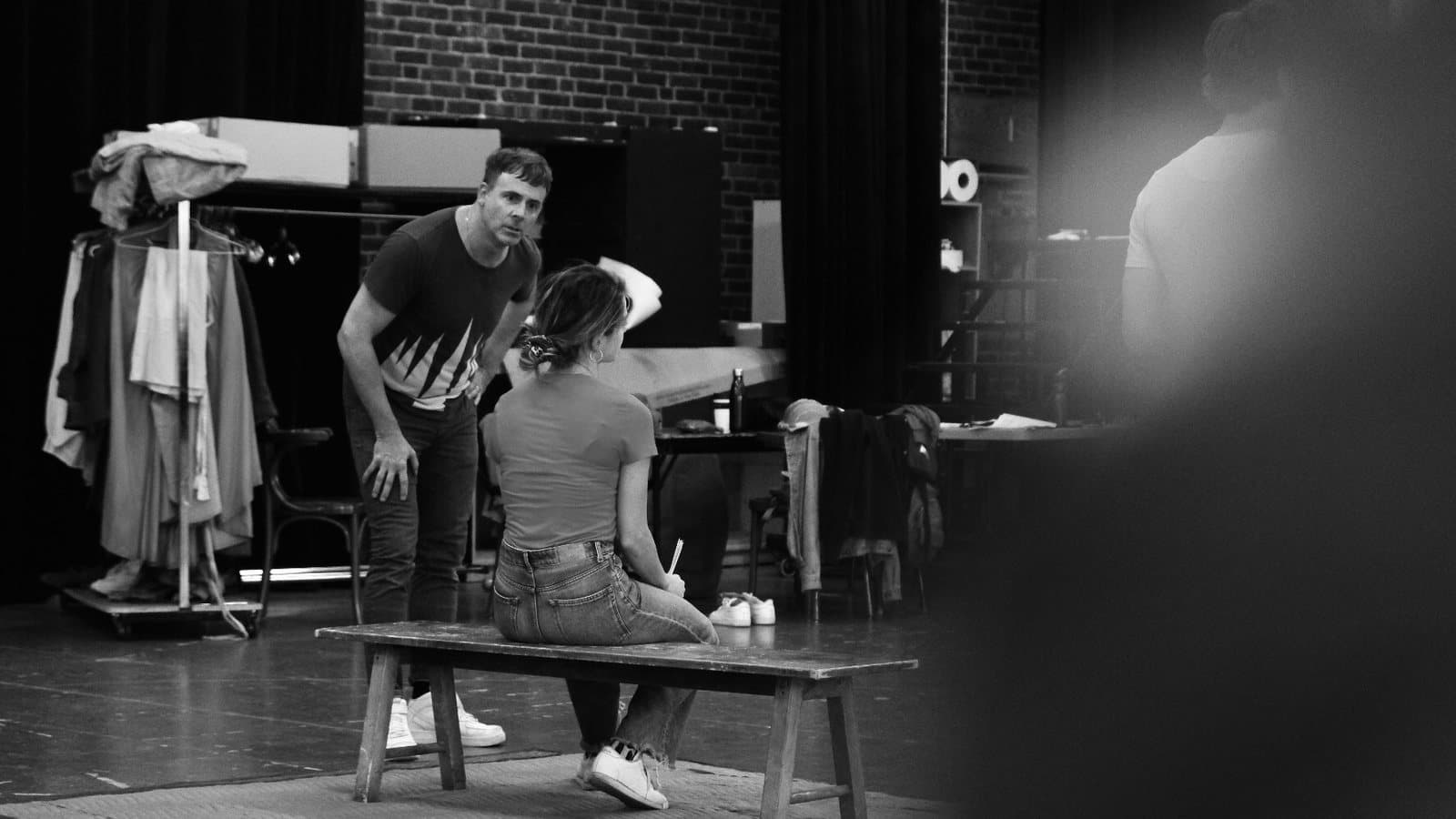
Every troupe has its habits, its inside jokes and its own way of getting through rehearsals. And yet some phrases seem to travel from one rehearsal room to the next. They pop up when someone blanks on a line, forgets a cross, gets the giggles and can't stop, or attempts a restart that's a little too ambitious.

They don't just say that the work is hard. They also capture what makes a troupe special: trust, mutual support, shared mishaps and the ability to start over one more time.

"Let's pick it up from just before"

This is probably one of the most misleading phrases in theater.

"Just before" can mean two lines earlier, the top of the scene, a character's entrance or sometimes an entire passage nobody had planned to redo. Everyone then mentally searches for the right spot while someone flips through the script with very relative urgency.

This phrase comes up a lot because a scene can't always be fixed word by word. To recapture an intention, a rhythm or a cue, you sometimes have to go back far enough to rebuild what comes before.

"I swear I knew it"

This one comes right after the blank.

You knew the text yesterday, in the kitchen, in the car or just before you started. Then your partner's line lands, you look up, and nothing comes.

That moment is frustrating, but it's part of the work. Knowing a line on your own doesn't guarantee it will be there at the right moment in the scene. You also have to learn what triggers it: a word, an intention, a silence or an action from your partner.

That's why Italian run-throughs and cue exercises are so useful. They put the line back in its context instead of working on it in isolation.

"Let's do it one last time"

Nobody really believes it.

The last time often becomes the second-to-last, then the "just to check" version, then the one where you finally try it with the right prop. And once the scene works, someone naturally suggests running it again from the top.

That extra run isn't always pointless. Sometimes it locks in a correction or confirms that a passage that worked once can be repeated. But it can also be a sign that it's time for a break.

Over time, a troupe learns to tell the difference between persevering and beating a dead horse.

"That was better, but…"

The "but" can be scary, especially after a scene that finally seemed to hold together.

Yet this phrase often shows that the work is moving forward. If something was better, it means an intention, a rhythm or a quality of listening has started to emerge. What comes next is simply pinning down what's still missing.

The most useful notes are concrete: slow down at a specific spot, wait for a reaction, change a cross or clarify the character's objective. A "that was better" then becomes a real foothold, not just vague encouragement.

"Who has my script?"

The script might be under a chair, in a bag, in the middle of the props or in the hands of someone who no longer remembers borrowing it.
Your lines, at your fingertips

Import your play into Synqro: your lines highlighted, the Italian run-through to give you the cue, and games to remember it. Free.

Rehearse your first text

Read next

  • 26 October 2026

    How to Learn Lines Without Rote Repetition: What Research Learned from Actors

  • Learn Your Lines at Night, Review Them in the Morning: What Sleep Does to Your Memory

    26 October 2026

    Learn Your Lines at Night, Review Them in the Morning: What Sleep Does to Your Memory

  • The Unsung Roles That Keep a Theater Troupe Going

    11 August 2026

    The Unsung Roles That Keep a Theater Troupe Going

These little moments are part of life behind the scenes. They're also a reminder that a rehearsal often depends on very simple organization: having the right version of the script, your notes, the props you need and a way to quickly find the scene you're working on.

On paper or on a phone, everyone ends up building their own system. What matters is that the medium helps the work rather than slowing it down.

"I'll give you the line"

This may be the most important phrase of all.

It means a partner saw you hesitate and chose to help without needlessly stopping the scene. Giving someone their line isn't just whispering the missing words. It's letting the work go on, then coming back to the shaky passage afterward.

That solidarity is at the heart of rehearsal. A troupe rarely improves because everyone works in their own corner. It improves because its members learn to listen to each other, support each other and fix things together.

Between rehearsals, prepare what you can

Group rehearsals are for building the acting, the relationships, the blocking and the overall rhythm. Part of the text, though, can be strengthened on your own between sessions.

With SYNQRO, actors can go over their scenes with an Italian run-through, or work with Initials or Blank text. Troupes can also use Collaborative Italian to rehearse with their scene partners' real recorded voices.

The goal isn't to eliminate every "I swear I knew it." Those moments will always happen. It's simply to make them less frequent so you can spend more time on the acting.

Discover SYNQRO

In conclusion

Rehearsal catchphrases make us smile because they're so familiar. They tell the story of the hesitations, the fatigue, the progress and the bonds that form over the weeks.

The next time someone announces "one last time," nobody will really be fooled. But the whole troupe will probably take their places again anyway. And that's part of why we love to rehearse.