July 24, 2026 · 5 min read
Stop Rereading Your Script Over and Over: Learn Your Lines with Active Recall
Rereading isn't always enough. Try an active recall routine that really tests your lines and zeroes in on the shaky passages.
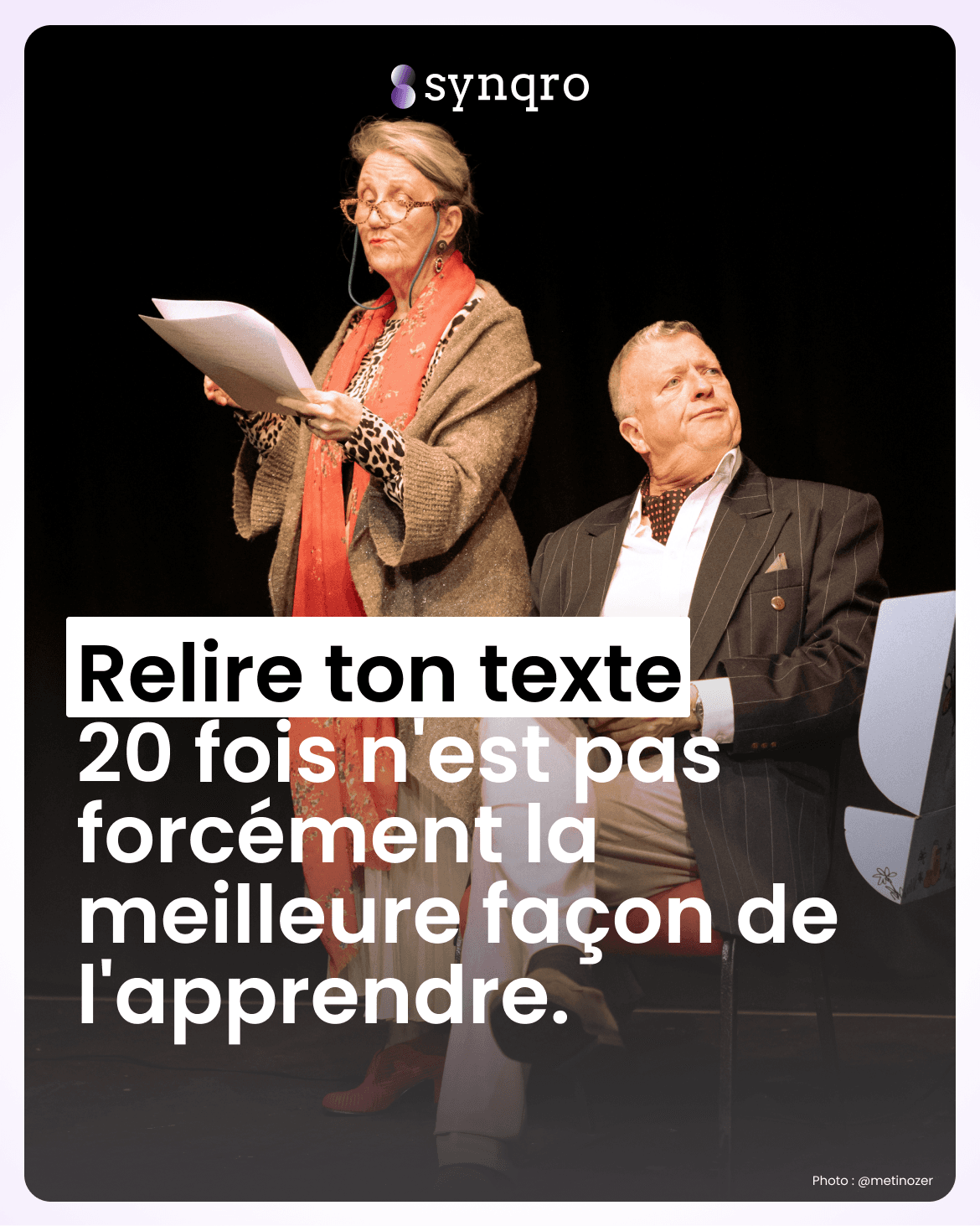
Rereading your script is reassuring. The sentences feel more and more familiar, the words seem to flow on their own, and sometimes you finish a page feeling like you really know it.
Then you close the script, your cue comes... and nothing.
This gap is common: recognizing a sentence when it's right in front of you is not the same as being able to find it on your own, at the right moment. To find out what you actually know, you need to gradually move away from reading and try to recall the text from memory.
Familiarity can be misleading
When you reread the same passage several times, your brain always meets the words in the right order. You never have to produce the sentence: it's already there in front of you.
That familiarity is useful at the start. It helps you understand the scene, notice the vocabulary, and begin to hear the rhythm of the text. But if the whole session is spent rereading, the hesitations can stay hidden until rehearsal.
A very simple test makes this obvious: after a few readings, cover the page and try to say your first line. The places where your memory stalls show you right away what still needs work.
How active recall works
Active recall means searching your memory for a piece of information before looking at the answer again. With a play script, that means trying to deliver a line, an entrance, or an exchange without immediately looking at the written words.
Research in cognitive psychology has shown that repeatedly retrieving information can support long-term retention more than simply continuing to reread it. This research was mostly done with classroom learning and vocabulary lists. Applying it to an actor's work is therefore a practical adaptation, not proof that a single method suits every text or every performer.
Read the study by Jeffrey Karpicke and Henry Roediger published in Science
A four-step routine
To apply this principle to a line, you can use a very short loop:
- read the line carefully;
- cover the text;
- say whatever you remember;
- look only at what's missing or what you changed.
Then start again. The goal isn't to recite it perfectly on the first try. Mistakes are part of the exercise: they show you exactly which word, phrasing, or transition isn't available to you yet.
Once the line holds, add the one that comes before it. You can read it, listen to it, or ask someone to give it to you, then try to answer without looking at your own text.
Work on your cues, not just your sentences
A line you know perfectly on its own can still be hard to find in the middle of a scene. The problem isn't necessarily the words, but the link with whatever triggers them.
Identify your scene partner's last words, an action, a question, or a shift in intention that comes right before you speak. Then try to start directly from that signal.
You can also vary your starting point. Begin in the middle of the scene, pick up after a long speech, or ask someone to choose a line at random. This variety keeps you from always needing the beginning of the passage to find what comes next.
Use the Italian run-through to check yourself
The Italian run-through (a rehearsal where you simply say the lines, with no acting or blocking) is especially well suited to active recall. The other characters' lines set up the context, but your own text is still yours to produce.
You can do a first run-through with the text visible. On the next one, try looking away or hiding your lines. Finally, go back over only the passages where you hesitated.
In SYNQRO, the Italian run-through lets you listen to the other characters' lines in a synthesized voice. For troupes using Collaborative Italian, those voices can be replaced with recordings from their scene partners. The exercise then becomes a way to find your cues from signals close to the ones you hear in rehearsal.
Discover SYNQRO's rehearsal methods
Initials and Blank text as in-between steps
Going straight from the full text to a completely hidden page can be hard. Intermediate prompts let you gradually increase the recall effort.
With the Initials method, only the first letters of the words stay visible. They give you something to hold on to without handing you the whole sentence. Blank text hides some of the words, so you have to find them while keeping part of the context.
These exercises are useful when a line is almost there but still has a few fuzzy spots. They let you reduce the help step by step, instead of always keeping the full text in front of you.
Correct yourself without learning your mistakes
After each attempt, check the exact version. If you replaced a word, changed a negation, or swapped two elements, reread the correct sentence and try it again.
It's often better to go straight back to a specific mistake than to restart the whole scene. Once the passage is fixed, put it back into a longer exchange to make sure it holds up in context too.
The text should still serve the artistic work, though. Some changes are decided together with the director, or with the playwright when that's allowed. Active recall is there to help you learn the version the troupe settled on, not to impose a rigidity that would get in the way of the acting.
The bottom line
Rereading is still a useful first step, but it isn't always a reliable test. To know whether a line is really there for you, you have to try to find it before looking at the answer.
At your next session, pick just five lines. Read one, cover it, say it, then check. You'll know right away what you already know and what deserves a few more tries.